
Burnout in Relief Veterinary Practice: What’s Driving Stress in Flexible Work?
Download Free CopyThis study was initiated by Serenity Vet in collaboration with Talkatoo to investigate the potential stressors in relief work and explore strategies to improve mental well-being in this group. It was prompted by findings from the 2025 AVMA Economic State of the Veterinary Profession report, which showed that while burnout among associate veterinarians has declined since the pandemic, burnout among relief vets has continued to rise – alongside the lowest overall satisfaction within the profession.
Conducted between June and August 2025, the survey gathered 151 responses from relief veterinarians. Burnout and professional fulfillment were measured using the Professional Fulfillment Index (PFI) – a validated tool developed at the Stanford University School of Medicine. The PFI assesses three core areas: work exhaustion, interpersonal disengagement, and intrinsic satisfaction. To support trend analysis, Galaxy Vets provided anonymized data from its burnout surveys conducted between 2020 and 2022 using the same methodology.
Rising Burnout and Emotional Fatigue among Relief Veterinarians
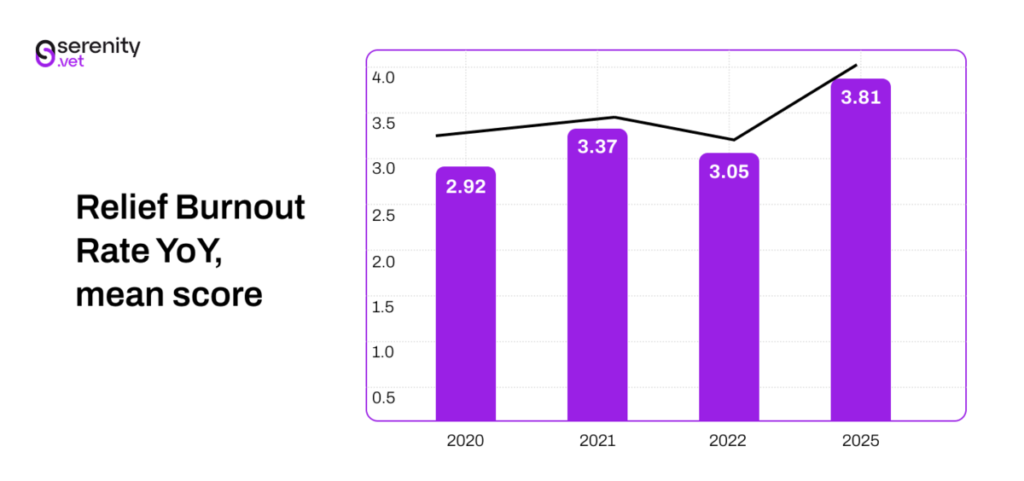
In 2025, burnout level among relief veterinarians rose by 25% compared to 2022, surpassing even the peak levels recorded during the COVID-19 pandemic.
Work exhaustion rose by 24%, and interpersonal disengagement increased by 29%, reflecting growing emotional fatigue among relief veterinarians and a sense of disconnection from patients, clients, and coworkers. At the same time, professional fulfillment rose by 32%, showing that relief veterinarians still find their work meaningful – even as they continue to experience mounting emotional pressure and exhaustion that may fuel burnout. The findings suggest that meaningful work doesn’t always protect against emotional and physical strain.
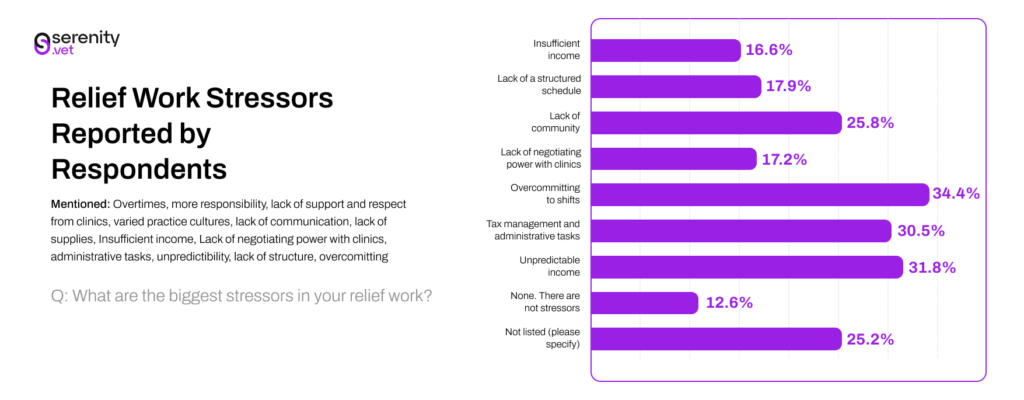
Relief veterinarians most commonly pointed to overcommitting to shifts (34.4%) as their top work-related source of stress, followed by income unpredictability (31.8%), administrative burdens (30.5%), and a lack of community (25.8%).
Open-ended responses revealed deeper contextual challenges, including limited onboarding, inconsistent clinic support, vague expectations, and difficulty integrating into clinic teams. These insights suggest that improving onboarding processes, clarifying expectations, and strengthening clinic-relief collaboration may help reduce the cognitive and emotional load associated with operating in unfamiliar settings.
Sense of Financial Security among Relief Veterinarians
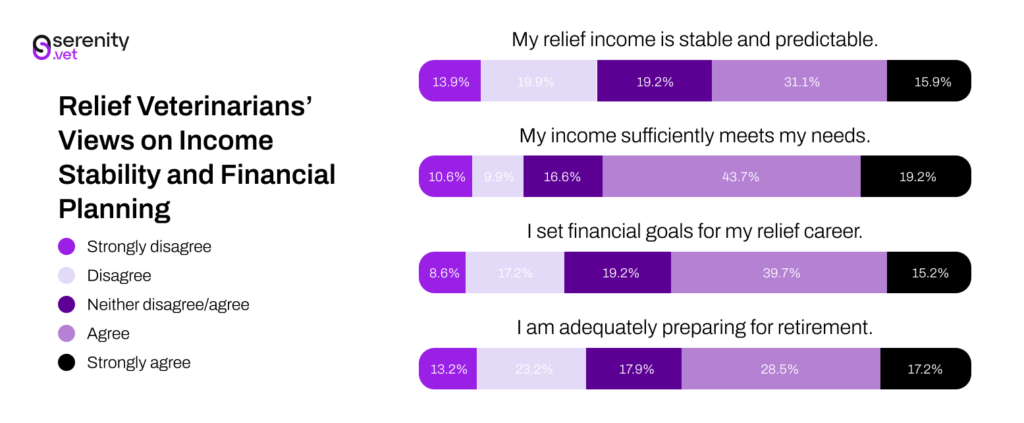
The study also explored how relief veterinarians perceive the stability of their income and careers overall. While 62.9% said their income meets their needs, 33.8% reported their earnings are unpredictable or struggled to answer this question. This gap between income sufficiency and consistency highlights a unique challenge in relief work: income may be sufficient overall, but hard to plan for. That uncertainty likely reflects shifting demand, inconsistent scheduling, and different approaches to rate negotiation. However, these financial concerns appear to have a lower impact on burnout among less experienced veterinarians.
Most relief veterinarians (65.5%) find shifts directly through referrals or by contacting clinics themselves, while 27.1% use staffing platforms or agencies. As for compensation models, hourly or per-shift pay was the most common preference, but 17.2% favored a flat rate with a production bonus. More than half of respondents (56.3%) said they negotiate their shift rates, but nearly one-third either struggle to negotiate effectively or avoid the payment-related conversation because it makes them uncomfortable.
Making relief work more stable and financially predictable will likely take both individual and industry-wide efforts. Relief veterinarians may benefit from clearer rate benchmarks, income forecasting, and financial planning tools. On the clinic side, reducing uncertainty can start with more transparent communication around expectations and more advance notice when scheduling shifts. Together, steps like these may help ease the financial ambiguity that potentially contributes to burnout.
Work-life Balance in Relief Practice
58.9% of relief veterinarians said they have a good balance between work and personal life, while 21.9% said they haven’t quite achieved that state; another 19.2% were unsure. Those who did report strong work-life balance were also more likely to feel financially secure.
Despite this general sense of balance and control, not all respondents felt confident about finding shifts that truly fit their needs – whether that means better pay, more predictable hours, or a specific type of work. While 47.7% said they could find shifts that met their criteria, 28.5% said they couldn’t, pointing to a gap between flexibility in theory and in practice.
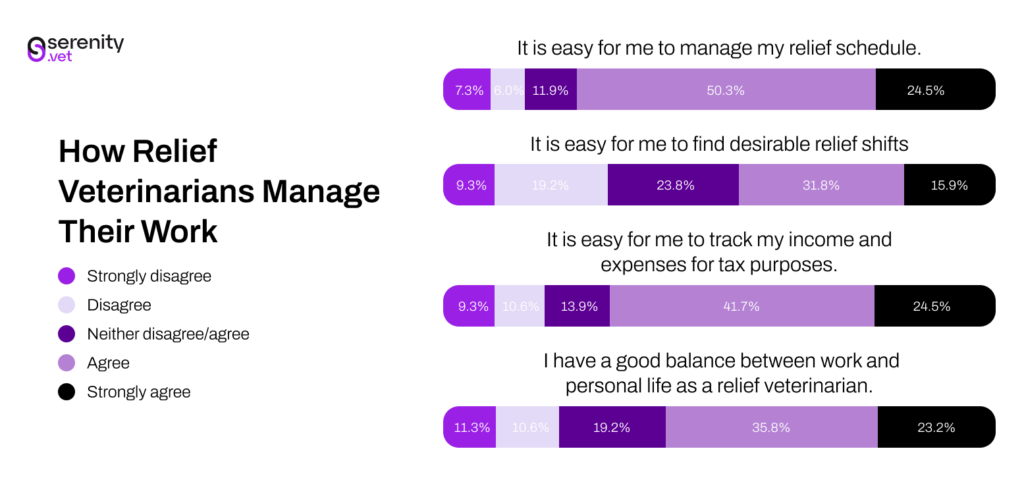
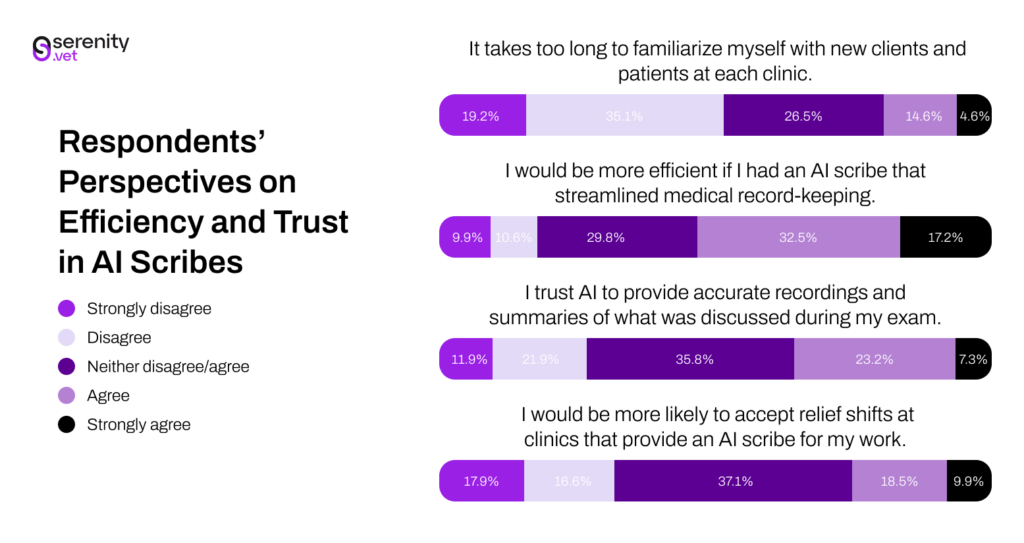
Tools that simplify scheduling, track income, or reduce paperwork could make a meaningful difference for both relief veterinarians and clinics. For clinics, offering AI-supported documentation may increase the appeal of their shifts for relief veterinarians, particularly those who prioritize efficiency or are concerned about after-hours paperwork.
AI Adoption Growth in Relief Veterinary Work
While adoption is still emerging, more than half of relief veterinarians have either used an AI scribe or are open to trying one. 49.1% reported using AI scribes at least occasionally, and among those who haven’t, 33.8% said they’re interested. Trust is building as well – 30.5% said they trust AI to help with documentation, and 28.5% would be more likely to take shifts at clinics that offer AI-powered tools.

Receive the free report in your inbox
Download the full white paper for deeper insights into the emotional well-being of relief veterinarians and the factors potentially contributing to burnout in this profession.