
How to Pick the Right Relief Model for Your Clinic
Most veterinary practices eventually reach a point where relief coverage becomes essential. The question isn’t whether you need it, it’s how to get it without hemorrhaging money, drowning in administrative chaos, or ending up with a rotating cast of strangers who don’t know how your clinic actually runs.
Too many practice owners approach this decision backwards. They pick a staffing model based on what’s convenient or what their neighboring clinic uses, then try to make it work. Six months later, they’re either overpaying or spending their evenings texting relief vets to fill next week’s schedule.
Here’s the reality: there’s no universally “best” way to staff relief veterinarians. But there is a best way for your clinic, based on how often you need coverage, how much administrative bandwidth you have, and whether you’re trying to patch a temporary gap or solve a permanent problem.
This guide breaks down four main approaches: traditional staffing agencies, per-shift marketplaces, subscription-based platforms, and full-time hires, with the actual costs, trade-offs, and decision framework you need to pick the right model.
Traditional Staffing Agencies: The Backup Plan
How They Work
Staffing agencies are the emergency room of veterinary relief. You call them when you’re desperate, and you pay accordingly.
The model is straightforward: the agency recruits, credentials, and manages a roster of relief veterinarians. When you need coverage, you contact them with your requirements (dates, hours, special skills), and they send someone. The agency handles payroll, malpractice insurance, and all compliance headaches. You pay a rate that typically runs 1.5 to 2.5 times what the veterinarian actually receives.
For example, if a relief vet earns $75 per hour, a clinic might pay $130–160 per hour to the agency. On a 10-hour shift, that’s a $1,300–1,600 expense. The premium covers the agency’s overhead, their recruiting efforts, the convenience of offloading HR complexity, and the guarantee that someone will show up.
When Agencies Make Sense
Agencies excel in three scenarios:
Short-notice coverage. Your associate gives you a few days’ warning that they need time off, or you realize mid-week that next Monday’s schedule is overstuffed. Agencies typically need a few days to a week of lead time, but they can often fill gaps faster than you could coordinate on your own—especially if you don’t have an existing relief network.
Clinics starting from zero. If you’re new to using relief vets and don’t have an existing network, agencies provide immediate access to credentialed professionals. You’re paying for their Rolodex.
Specialized or difficult-to-fill needs. Looking for a relief vet with surgery experience willing to work in a rural area two hours outside the city? The agency’s network might be your only realistic option.
The Real Costs
The obvious cost is the rate markup. But the hidden costs matter just as much:
You typically get whoever is available, not necessarily who’s good. The vet showing up Thursday might be fantastic. Or they might be the person every other clinic has learned to avoid. You won’t know until they’re at your clinic.
There’s also minimal relationship continuity. Even if you love the vet the agency sends, there’s no guarantee you’ll get them again. You’re constantly onboarding new people to your protocols, your EMR system, and the countless unwritten preferences that shape how your clinic runs.
And perhaps most importantly: you’re not building an asset. Every dollar you spend with an agency evaporates the moment that shift ends. You’re not developing relationships with relief vets who know your practice, your clients, your team culture.
Bottom Line
Agencies are expensive insurance. Use them when the alternative is turning away appointments or closing for the day, but recognize you’re paying a substantial premium for convenience and speed. If you’re using an agency more than once a month, you’re probably overpaying for what could be solved with a different model.
Find Relief Vets on Your Terms
Set the rate, pick the vet, and keep your clinic running at full speed.
Traditional Relief Marketplaces: The Shift-by-Shift Approach

How They Work
Relief marketplaces—platforms where you post available shifts and veterinarians apply or bid for them—brought a Silicon Valley approach to an old problem. Instead of calling around or relying on personal networks, you log into a platform, list your needs, and wait for vets to respond.
The clinic typically pays either a flat booking fee per shift, or a percentage of the shift cost (usually 10-20%). Some platforms combine both. The veterinarian handles their own taxes and insurance, so you’re paying them as an independent contractor.
When Marketplaces Work Well
Marketplaces shine when your relief needs are occasional and predictable.
If Dr. Chen takes off the first Monday of every month for CE, you can post those shifts well in advance. Relief vets appreciate the advance notice, you get multiple applicants to choose from, and the per-shift fee feels reasonable when you’re only doing this 12 times a year.
Marketplaces also work beautifully for trying out multiple relief vets without commitment. Think of it as dating before marriage. You can rotate through several candidates, see who meshes with your team, who your clients respond to, and who actually knows how to use your ultrasound machine without calling for help every fifteen minutes.
Where the Model Breaks Down
The math starts working against you when relief becomes regular. If you’re booking 8-12 shifts a month at $160-250 per booking, that’s $1,280-3,000 in platform fees alone, before you’ve paid a single veterinarian. Multiply that by twelve months, and you’re spending $15,360-36,000 annually just for the privilege of access.
There’s also the administrative load. Every shift requires a separate posting, separate communication, separate invoicing. When you’re juggling multiple relief vets across multiple weeks, you’re spending an hour or more each week managing the logistics. That’s an hour your practice manager isn’t handling the fourteen other things on her plate.
Bottom Line
Marketplaces make sense for clinics with occasional, predictable relief needs: roughly 4 shifts or fewer per month. They’re also excellent for the “audition phase” when you’re trying to build a stable of reliable relief vets. But if you’re consistently booking multiple shifts every month, the per-shift fees and administrative overhead add up fast.
💡 Ready to start finding relief vets?
Check out our companion post,
How to Find a Relief Vet: Vetting, Booking, and Getting the Right Fit
— it covers how to actually find good candidates, figure out if they’re the right fit, and get them started at your clinic.
Subscription-Based Platforms: The Serenity Vet Model
How They Work
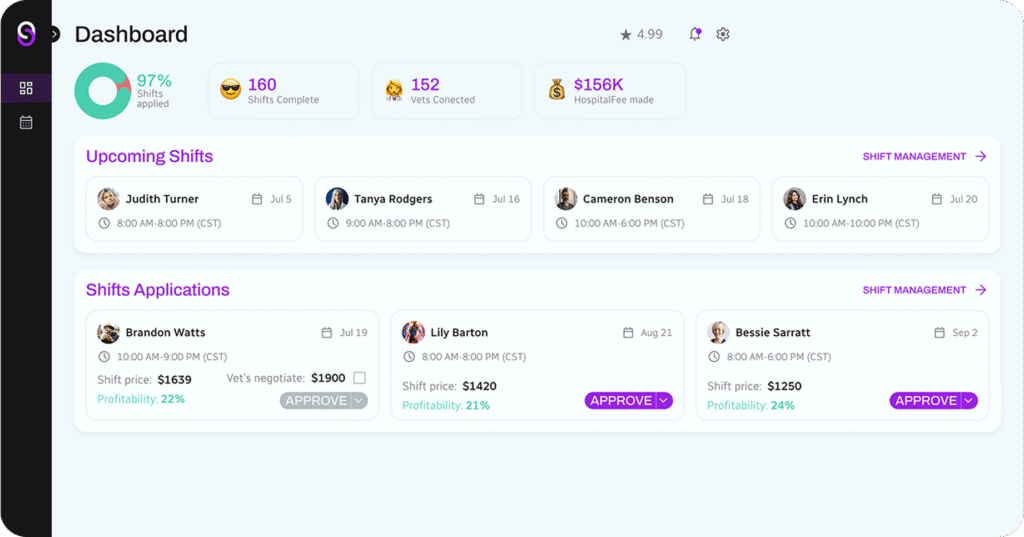
Subscription platforms flip the traditional marketplace model on its head. Instead of paying per shift, you pay a flat monthly fee based on how many relief veterinarians you have in your rotation, not how many shifts you actually book.
With Serenity Vet’s model specifically, a clinic might pay a set monthly rate to manage up to, say, three relief vets. Whether those vets work two shifts or twenty shifts that month, the platform cost stays the same. The platform provides the scheduling infrastructure, invoicing and analytics tools. You can bring your existing relief vets onto the platform, or discover new ones through their network.
The veterinarians themselves are paid directly for their time (you set the rate), and you’re just paying for the management infrastructure that makes everything run smoothly.
When Subscription Models Excel
This model is purpose-built for clinics with regular, ongoing relief needs, let’s say 4 or more shifts per month, consistently.
Here’s why the math works: if you’re booking 8 shifts a month on a traditional marketplace at $160-250 per booking, you’re spending $1,280-2,000 monthly just in platform fees. A subscription model with three relief vets might cost $299 per month regardless of shift volume. The break-even point hits fast.
But the financial advantage is only part of the story. The bigger win is relationship continuity.
When you’re not paying per shift, you’re incentivized to work with the same small group of relief vets repeatedly. They learn your protocols. Your team learns their quirks. Clients see familiar faces. You’re building something closer to a flexible part-time staff than a rotation of strangers.
This is especially valuable for practices with specific cultural expectations or complex caseloads. If you run a high-volume spay/neuter clinic, your relief vet needs to move fast and stay efficient. If you’re a referral practice doing advanced orthopedic work, your relief vet needs to be technically excellent and comfortable with worried clients. The subscription model gives you the space to develop these relationships without watching the meter run.
The administrative relief is real, too. Everything lives in one system: scheduling, communication, invoicing, credentialing checks. Your practice manager isn’t juggling three different platforms, five email threads, and a text conversation to coordinate next week’s coverage.
The Limitations
If you’re starting from scratch with no existing relief network, you’ll need to invest time upfront finding vets and building those relationships. The platform can help with discovery, but you’re still doing the work of evaluating candidates and establishing fit.
There’s also the psychological hurdle of paying a monthly fee even during slow months. If August is dead and you only need one relief shift, you’re still paying the subscription cost. Over a full year, this usually evens out, but it requires thinking about relief staffing as infrastructure, not a variable expense.
That said, Serenity Vet offers scaled pricing that addresses this concern. If you’re only working with a single relief vet, the monthly cost can be minimal or even free aside from basic payment processing fees. This makes the model more accessible for practices testing the waters or with genuinely light, irregular needs.
The model becomes overkill primarily if you need coverage only a handful of times per year and don’t see that changing. But if there’s any chance your relief needs will grow, or you want the infrastructure in place before you’re scrambling, starting with a low-cost subscription tier can make sense even at lower volumes.
Bottom Line
Subscription platforms are ideal for practices with consistent, predictable relief needs who value relationship continuity and administrative simplicity. If you’re booking 4+ shifts per month and tired of paying per-shift fees, this model deserves serious consideration. The break-even math is straightforward, but the intangible benefits—vet familiarity, reduced coordination overhead, relationship depth—often matter more.
The Full-Time Hire: When Relief Becomes Permanent

When to Stop Patching and Start Hiring
At some point, you’re not managing a temporary gap. You’re running a chronically understaffed practice and pretending it’s temporary.
The inflection point usually hits when you’ve been booking 12-15+ shifts per month for three consecutive months, with no end in sight. You’re not covering vacations or parental leave anymore. You’re covering normal operational volume.
Here’s the math: if you’re paying a relief vet $100/hour for 12 shifts per month at 10 hours each, that’s $12,000 per month, or $144,000 annually, before any platform fees or agency markups. A full-time associate making $110,000 per year, with benefits (add 25–30% for health insurance, retirement matching, PTO, and CE allowance), costs roughly $137,500–143,000 all-in.
You’re already paying nearly the same amount. But with relief, you get less loyalty, consistency, and long-term value. The relief vet isn’t mentoring your new technician, isn’t building client relationships, and isn’t contributing to the culture you’re trying to create.
The True Cost of Full-Time
That said, full-time employment isn’t just relief costs plus benefits. There are hidden expenses:
Recruiting costs run $5,000-15,000 when you factor in job postings, headhunter fees (if used), interview time, and the opportunity cost of leaving the position open while you search.
Onboarding and training consume 20-40 hours of senior team time in the first month alone. Your lead technician isn’t just teaching someone where the dental supplies are; they’re calibrating expectations, explaining protocols, and covering for inevitable mistakes during the learning curve.
Reduced flexibility means you’re paying for 40 hours a week even during your slow season. Relief vets let you scale down in January; a salaried associate does not.
Signs You’re Ready
You know it’s time to hire full-time when:
- Relief costs have exceeded what an associate’s salary would be for three or more consecutive months
- You have a clear, consistent schedule gap of 30+ hours weekly
- Client complaints about “never seeing the same vet” are becoming frequent
- Your relief vets are turning down shifts because they’ve found more stable arrangements elsewhere
- Your practice growth trajectory supports the additional fixed cost
One underrated signal: when you find yourself wishing a specific relief vet would just stay. That’s your gut telling you the relationship has outgrown the transactional model.
Bottom Line
Full-time hires are the right move when your need for coverage has become structural, not situational. If you’re spending six figures annually on relief and your volume supports it, you’re not saving money, you’re just avoiding commitment. But if your relief needs are genuinely variable or you’re not yet sure the volume will sustain, the flexibility of relief coverage is worth its premium.
The Decision Framework: How to Choose

Start with Volume
The single biggest determinant is how often you need coverage:
Occasional (fewer than 4 shifts/month): Traditional marketplace or agency as needed. Keep it simple and variable.
Regular (4-12 shifts/month): Subscription platform. The math tilts heavily in favor of flat-rate infrastructure.
Heavy (12-15+ shifts/month, consistently): Evaluate full-time hire. You’re at or past the financial break-even point.
Factor in Predictability
Volume matters, but so does consistency.
If you need 8 shifts per month but they’re spread unpredictably (covering sick days, emergency leave, surprise surges) a subscription platform or marketplace gives you flexibility. If those 8 shifts happen every month like clockwork because Dr. Martinez works a reduced schedule, you’re much closer to needing a part-time or full-time associate.
Consider Administrative Bandwidth
Be honest about your practice manager’s capacity. If they’re already stretched thin managing the twelve other software platforms you’ve adopted, adding shift-by-shift scheduling and invoicing for multiple relief vets might be the breaking point. Subscription platforms consolidate this overhead. Agencies eliminate it entirely (at a steep cost). Marketplaces add to it.
Value Relationship Continuity
Some practices genuinely don’t care who shows up, as long as they’re competent and licensed. High-volume wellness clinics, urgent care practices with lots of walk-ins, and spay/neuter-focused operations can often function perfectly well with rotating relief.
Other practices (with complex medical cases, anxious clientele, or strong team cultures) suffer badly when there’s a revolving door of unfamiliar vets. If relationship continuity matters to your practice identity, bias toward models that encourage repeat work with the same people: subscription platforms and full-time hires.
Don’t Ignore the Hybrid Approach
Here’s what many successful practices figure out: you don’t have to pick just one model.
A common hybrid: maintain 2-3 reliable relief vets through a subscription platform for regular, predictable coverage, then keep an agency on speed-dial for true emergencies. You get relationship continuity 90% of the time and a backup plan when everything goes sideways.
Another version: hire a full-time associate to cover your baseline needs, then use a subscription platform to manage 1-2 relief vets for busy seasons, vacations, and overflow. You’re not dependent on relief, but you’re not trapped in an understaffed nightmare either.
The worst mistake is rigid thinking. Your staffing model should flex with your practice’s reality, not the other way around.
Making the Call
If you’ve been limping along with a patchwork approach, maybe it’s time to get intentional.
Run the actual numbers. Calculate what you’ve spent on relief in the past three months. Multiply by four. Is that number higher than an associate’s salary? Are you getting the consistency and quality that cost deserves?
Ask your team. Your practice manager knows whether the administrative load is sustainable. Your lead technician knows whether the rotating cast of relief vets is creating problems with patient care or team morale.
And be honest about your growth trajectory. If your practice is trending up, relief coverage isn’t a stopgap, it’s infrastructure. Invest accordingly.
The right staffing model isn’t the one that’s cheapest or easiest or most popular in your AVMA Facebook group. It’s the one that matches your volume, your budget, your administrative capacity, and your practice’s identity. Once you know that, the decision is simpler than you think.
🩺 Find Relief Vets on Your Terms
Set the rate, pick the vet, and keep your clinic running at full speed.