
Veterinary Practice Profitability: Understanding Your Margins and How to Improve Them
Running a veterinary practice has never been more complex. Demand for pet care is softening across the industry, yet costs keep climbing, staff turnover disrupts operations, and client price sensitivity is real, even among devoted pet owners. Many practice owners find themselves working harder than ever while margins quietly erode.
The problem is rarely a lack of revenue. More often, it’s a lack of visibility into where that revenue actually goes and which parts of the business are negatively impacting profitability. Understanding your margins can be the difference between a practice that grows sustainably and one that stays perpetually stretched.
This guide breaks down what margins actually matter, what’s eating into yours, and what you can do about it.
Why Margins Matter More Than Revenue

It’s easy to focus on top-line revenue: monthly billings, year-over-year growth, appointment volume. These numbers feel good and are easy to track. But revenue alone doesn’t tell you whether your practice is actually financially healthy.
Margins do. Here are the three you should have a handle on:
Gross margin is the revenue left after direct costs: primarily drugs, supplies, and lab fees. If you’re billing $1,000 and spending $400 on the products and services that make that visit happen, your gross margin is 60%. A healthy gross margin for a veterinary practice typically sits between 55% and 70%, depending on your service mix.
Operating margin takes that gross profit and subtracts your operating expenses: staff wages, rent, utilities, equipment, software. This is where most practices feel the squeeze, because labor costs alone can account for 40–50% of revenue.
Net margin is what’s left after everything including debt service, taxes, and owner draws. For independent practices, net margins of 10–15% are generally considered solid. Many practices are operating well below that without realizing it.
Your goal is to track them consistently so you can spot trends early and make informed decisions, not reactive ones.
The Biggest Margin Killers in Veterinary Practices
Most profitability problems in veterinary practices come from a handful of recurring culprits. Some are obvious; others are slow leaks that only become visible over time.
Out of Control Labor Costs

Labor is the single largest expense in most practices, and it’s the hardest to manage well. Staff wages, benefits, overtime, and the hidden cost of turnover (recruiting, onboarding, lost productivity) can quietly push your staff cost ratio well past the healthy range.
One area where practices often lose money without realizing it: staffing for peak demand without adjusting for quiet periods. Many practices carry full-time headcount year-round to cover summer rushes or holiday spikes, then absorb idle capacity during slower stretches. The math rarely works in their favor.
Relief veterinarians are often misunderstood on this front. Some practice owners see them as an expensive last resort, something you bring in when a vet calls in sick. But when managed strategically, relief staffing is actually one of the more effective tools for right-sizing your labor costs. Instead of carrying full-time overhead through slow seasons, you can scale capacity up and down based on actual demand. The key is knowing what a shift actually costs you before you post it, more on that in the next section.
What complicates this further is that the traditional model for sourcing relief vets — going through platforms and staffing agencies that charge per-shift fees — adds another layer of cost that can be hard to track and easy to underestimate. Those fees compound quickly, especially for practices that use relief coverage regularly.
Inventory and Drug Costs
Pharmaceuticals and supplies typically represent 20–25% of revenue in a well-run practice. When that number creeps up, it’s usually due to one of a few things: over-ordering that leads to expired stock, inconsistent purchasing that bypasses negotiated supplier pricing, or shrinkage that nobody’s tracking closely enough.
A regular inventory audit, even a basic one, can surface surprising losses. If your drug cost percentage has drifted upward over the past year, that’s worth investigating before assuming it’s just the cost of doing business.
Services Priced Below Their Actual Cost
Fee schedules have a way of becoming institutional fixtures. Practices set them, get comfortable with them, and then hesitate to update them, even as costs rise. The result is that services that were marginally profitable five years ago are now losing money.
This is especially common with time-intensive services like dental procedures, wellness exams, and behavioral consultations, where staff time is the primary cost and that cost has risen steadily with wage inflation. If you haven’t done a formal fee review in the past 12–18 months, it’s worth the time.
Unused Capacity and Scheduling Gaps
Empty appointment slots are expensive. When an exam room sits idle or a veterinarian is on the clock but underbooked, you’re paying for capacity you’re not using. This is especially true in practices that schedule conservatively to avoid overbooking: a reasonable instinct that can quietly cost thousands per month in lost revenue.
Good scheduling isn’t just about being full. It’s about matching the right level of staffing to the actual patient demand for any given day, week, or season.
All-in-One Relief Management Platform
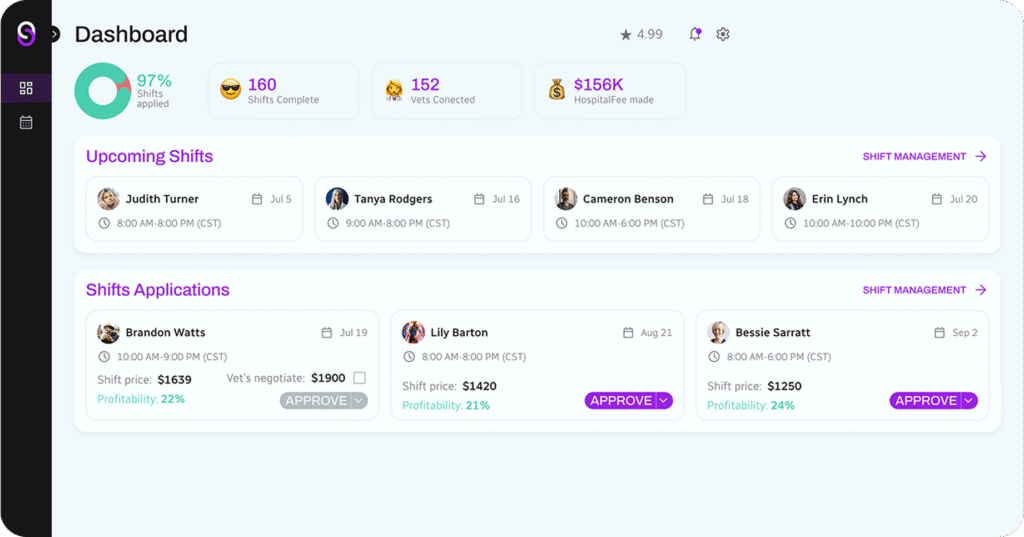
Build your network, set your rates, and access backup coverage when you need it
How to Actually Improve Your Margins
Identifying the problems is the easier half. Here’s what meaningful improvement actually looks like in practice.
Audit Your Fee Schedule and Keep Auditing It
Price increases are uncomfortable, but they’re necessary. The key is making them systematic rather than reactive. Set a calendar reminder to review your fee schedule every 12 months at minimum. Cross-reference your costs for each service, including staff time, and make sure you’re pricing for the actual cost of delivery, not the cost from three years ago.
Benchmarking against what similar practices in your area charge is also worth doing, though price alone shouldn’t drive the decision. Your pricing should reflect your costs, your quality of care, and the value clients receive.
Get Smarter About Inventory
Implement a basic inventory tracking system if you don’t have one. Even a spreadsheet that logs stock levels, usage rates, and expiration dates will reveal patterns you can act on. For practices that spend heavily on pharmaceuticals, it’s worth exploring group purchasing organizations (GPOs), which negotiate better supplier pricing based on collective volume.
The goal is to get your drug and supply cost percentage to a predictable, manageable level and to stop absorbing waste you haven’t noticed.
Treat Staffing as a Variable You Can Actually Control
This is where many practices leave the most money on the table. The default assumption is that staffing is mostly fixed: you have your team, you pay them, and that’s the cost. But there’s real flexibility available if you’re willing to build it into your model.
The most effective practices tend to use a core full-time team for baseline demand, with relief vets covering peaks, vacations, and unexpected absences. You’re only paying for clinical capacity when you actually need it.
The catch is execution. To make this work profitably, you need to know the actual cost of each shift before you commit to it, including the relief vet’s rate, your own overhead, and the revenue you expect to generate. That calculation sounds simple but is easy to get wrong, especially under pressure.
Serenity Vet addresses this directly: you can see your profitable range for any shift before posting it, set a minimum profitability threshold, and the platform will flag (or block) any rate that would push you below it. That includes during rate negotiations, which is often where the math quietly gets away from you. It’s a small thing that removes a meaningful source of margin leakage.
It’s also worth noting that the fee structure matters here. Platforms that charge per-shift fees add cost at exactly the point where you’re trying to improve margins. A subscription model, by contrast, keeps your cost of using the platform predictable and often lower, particularly for practices that rely on relief coverage more than occasionally.
Use Data to Drive Scheduling Decisions
Look at your appointment data by day of week, time of day, and season. Identify your consistently slow periods and your reliably busy ones. Then build your staffing model around that reality rather than a generalized assumption about what a normal week looks like.
If Tuesdays are consistently quiet, that’s the day to schedule training, admin catch-up, or proactive team development. If August is consistently your busiest month, that’s when relief coverage earns its keep.
The KPIs Worth Tracking

Improving profitability requires measuring the right things. A few metrics worth tracking consistently:
Revenue per doctor hour is one of the clearest indicators of clinical efficiency. If this number is low or declining, the problem is usually scheduling density, appointment length, or service mix, all of which are addressable.
Staff cost as a percentage of revenue should sit somewhere in the 40–50% range for most practices. If it’s creeping toward 55% or above, that’s a signal worth investigating. Relief staffing patterns, overtime, and turnover costs all show up here.
Average transaction value (ATV) reflects the average revenue generated per client visit. A declining ATV can indicate underpricing, a shift toward lower-value services, or missed opportunities to recommend diagnostics and preventive care.
Client retention rate is often overlooked as a profitability metric, but it matters enormously. Acquiring a new client costs significantly more than retaining an existing one. If your retention rate is below 70–75%, improving it will have a direct and measurable impact on your margins.
Review these on a monthly basis, not just at year-end. Monthly visibility means you catch trends before a slow leak becomes a serious problem.
Running a Tighter Ship, Not a Smaller One
Profitability improvement isn’t about cutting corners or squeezing every dollar out of your team. Done right, it’s about building the kind of operational clarity that lets you make confident decisions on pricing, staffing, investment in equipment or expansion.
The practices that sustain strong margins over time aren’t necessarily the busiest ones. They’re the ones that understand their numbers, review them consistently, and treat operational efficiency as a competitive advantage, not an afterthought.
That clarity is achievable for practices of any size. It just takes the right metrics, the right habits, and, increasingly, the right tools.
Manage Relief Coverage Your Way
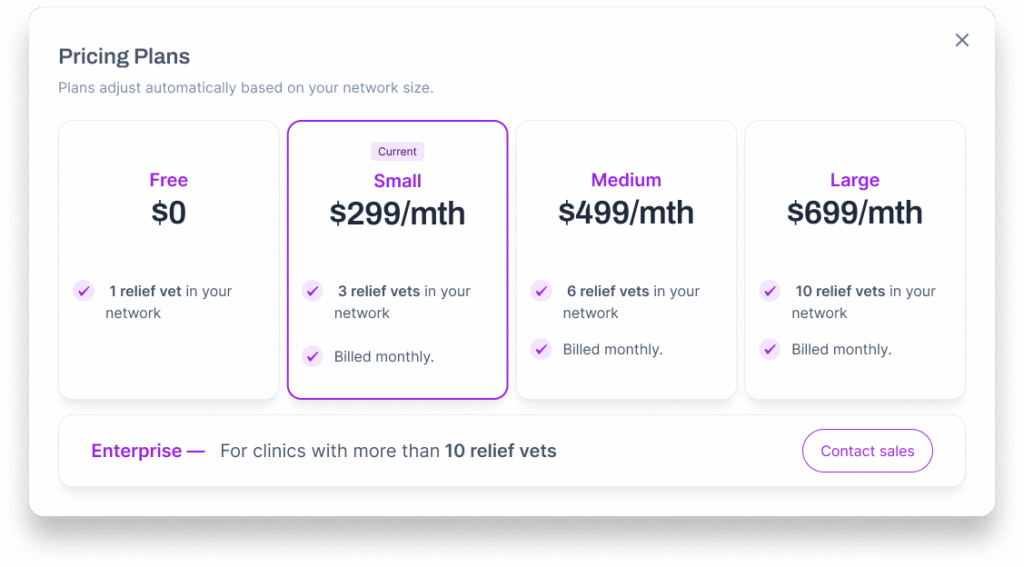
Manage your trusted vets with no marketplace fees and full scheduling control